
This report is based on original survey data collected directly from UK teachers through the Only for Teachers platform. All insights and findings are unique to our community.
Published: 12 April 2026 | Source: Only for Teachers original survey data
As the Department for Education continues to navigate the complexities of the 2026/27 National Funding Formula (NFF) allocations, the conversation often stays at a high level, focusing on billions of pounds in total school spending. However, for those on the front line, the reality of school funding is felt through the quality of a pen, the speed of a laptop, and the transparency of a departmental budget. Our latest survey highlights a growing information void, where the majority of teachers feel disconnected from the strategic financial decisions that shape their daily working lives.
The transparency deficit in school strategic funding
Perhaps the most striking finding from our latest research is the lack of visibility teachers have into their school’s financial management. While Senior Leadership Teams (SLT) and Academy Trusts grapple with the school budgets and SEND premiums, the message is not filtering down to the classroom.
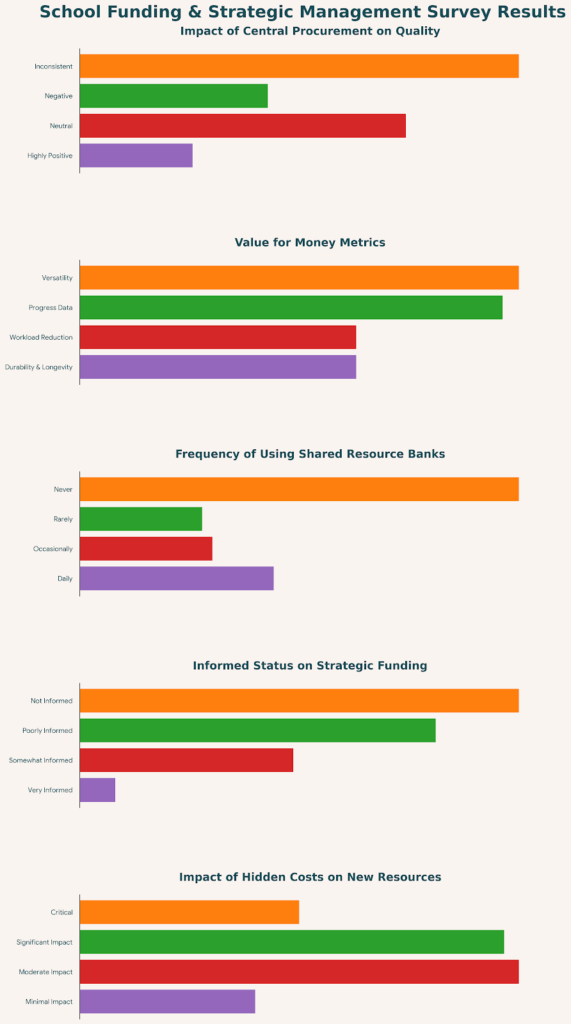
According to our data, a staggering 76% of teachers feel either ‘poorly informed’ or ‘not informed’ about how strategic funding is allocated to their specific needs. Only 3% of teachers reported being ‘very informed’ with access to regular budget breakdowns. This suggests that while schools may be making strategic choices to stay afloat, the lack of consultation is leaving teachers feeling like passive observers in their own departments.
The hidden costs of maintaining the status quo
The financial pressure on schools in 2026 is not just about a lack of new money, but where the existing money is going. The rise of hidden costs ranging from software subscription hikes to the maintenance of ageing hardware, is effectively stagnating classroom innovation.
Over 67% of teachers reported that these hidden costs have a ‘significant’ or ‘moderate’ impact on their ability to secure new resources. For many, the ‘new’ budget is inaccurate; 33% of teachers noted that a large portion of their funding is actually spent just maintaining the status quo. This ‘treading water’ effect means that while the bottom line of a school budget might look stable, the actual purchasing power for fresh, high-quality learning materials is diminishing.
Procurement and the one-size-fits-all trap
In an effort to find efficiencies, many schools and Multi-Academy Trusts (MATs) have moved toward central procurement systems. The theory is sound: buying in bulk should lower costs and raise quality. However, the teacher experience of these systems is decidedly mixed.
The largest group of respondents (40%) described the impact of central procurement as ‘inconsistent.’ While there is often a notable price improvement when purchasing high-ticket items like technology, basic consumables like paper and pens are frequently reported to be of lower quality. Furthermore, 17% of teachers expressed frustration with a one-size-fits-all approach, receiving generic resources that do not suit their specific subject specialisms or the unique needs of their students.
Conclusion
The data suggests that the budget and funding challenge most schools are facing is as much about communication as it is about currency. When teachers are excluded from the financial narrative, it creates a disconnect between school strategy and classroom reality. Efficiency measures like central procurement and digitisation only truly succeed when they enhance, rather than hinder, the specific subject needs of the staff using them.
How is your school’s budget transparency or do you have a question for your peers? We want to hear your views. Participate in next week’s survey to keep the conversation going.
Join the conversation and participate in our next weekly survey.
Join the conversation by participating in next week’s survey to ensure your professional voice shapes the UK education debate.
Our Methodology
About This Survey
All insights published on OnlyForTeachers come directly from teachers across the UK. Each week, we run original surveys on topics that matter most to educators — from classroom practice and workload to wellbeing and policy changes.
Who Takes Part
Participants are active UK teachers who have registered with OnlyForTeachers. Every response remains fully anonymous.
How We Collect Data
Our surveys are designed and distributed weekly through the OnlyForTeachers platform. Questions are short, relevant, and built to capture honest opinions efficiently. Each survey typically runs for one week, and responses are gathered using secure, GDPR-compliant forms.
Data Integrity
We ensure one response per teacher, prevent duplicate entries, and apply basic data cleaning before publishing results. No weighting or external adjustments are made — what you see reflects the real voices of UK teachers.
How We Analyse & Publish
Responses are aggregated and summarised by the OnlyForTeachers research team. Results are published exclusively on our website and social channels and are original to this community. When relevant, we also feature selected teacher comments to add qualitative insights.
Use of Insights
You’re welcome to reference or cite our findings in your articles, research, or policy papers — please credit: “Source: OnlyForTeachers – Original UK Teacher Survey Insights”