
This report is based on original survey data collected directly from UK teachers through the Only for Teachers platform. All insights and findings are unique to our community.
Published: 2nd March 2026 | Source: Only for Teachers original survey data
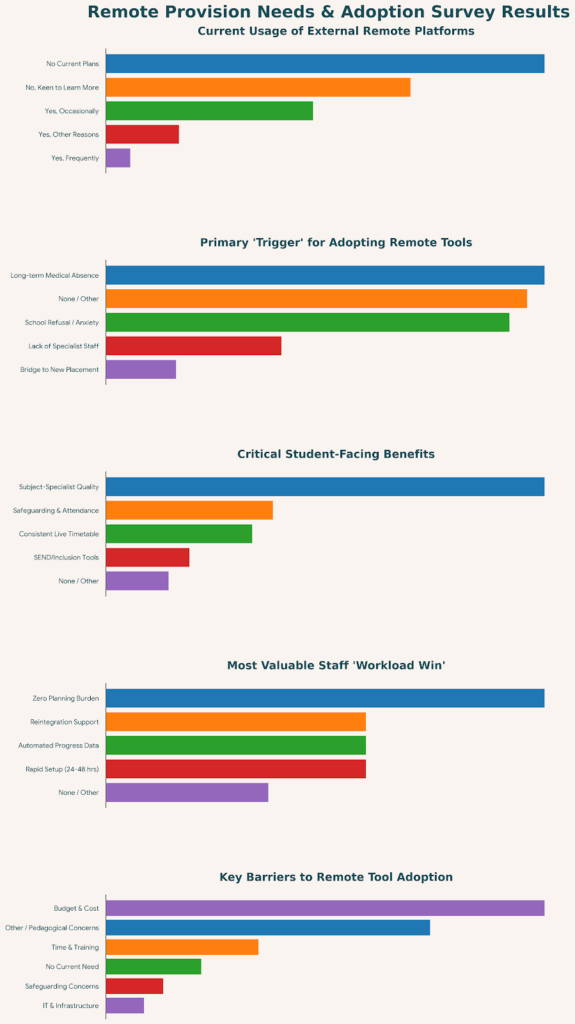
As the Department for Education (DfE) continues to focus on ‘attendance hubs’ and the persistent challenge of severe absence, the role of digital technology has moved beyond the emergency measures of the pandemic era. Today, the conversation is shifting towards how remote learning provision can offer a permanent, high-quality safety net for students who cannot access the physical classroom. Our latest survey reveals nearly 60% of our community are either already using or are keen to explore external platforms. However, they are clear that any digital solution must meet rigorous standards of specialist expertise and safeguarding.
Addressing the attendance crisis
The primary drivers behind the adoption of remote platforms are no longer school closures, but the nuanced and growing attendance crisis. When asked what would trigger the adoption of an external remote learning tool, teachers pointed directly to the most complex cases currently facing school leaders. 29.1% cited long-term medical absences where in-school support is no longer feasible, while 26.7% identified the rising tide of school refusal and anxiety (often referred to as Emotionally Based School Avoidance, or EBSA).
In this context, alternative provision schools and mainstream settings alike are looking for ways to maintain academic momentum without further stretching the capacity of on-site staff. The data suggests that remote provision is increasingly viewed as a vital ‘bridge’ for students waiting for placements or those requiring a reintegration pathway that respects their mental health needs.
Specialist expertise and teacher workload reduction
One of the most definitive findings from our survey is the value teachers place on professional expertise. A significant 52.3% of respondents ranked access to subject-specialist teachers as the most critical student-facing benefit of an online provider. In an era of recruitment shortages, the ability to outsource teaching to a qualified specialist rather than relying on pre-recorded videos or non-specialist cover is seen as a non-negotiable.
From a leadership perspective, the focus is squarely on reducing teacher workload. The most desired ‘workload win’ for 31.4% of teachers is a ‘zero planning’ model, where the external provider handles all curriculum alignment and lesson preparation. This is followed by the need for seamless data reporting (18.6%) to satisfy internal tracking and Ofsted requirements without adding to the administrative ‘digital drag.’
Navigating the barriers of cost and safeguarding
Despite the clear appetite for these tools – with 29.1% of teachers currently ‘keen to understand more’, significant hurdles remain. Unsurprisingly, in a climate of tightened school budgets, cost and financial constraints were the most frequently cited ‘internal’ hurdles. Many teachers expressed concern that while the technology exists to support school refusal strategies, the funding to implement them is often ring-fenced or simply unavailable.
Safeguarding also remains a concern. Teachers raised valid questions regarding engagement, such as the difficulty of monitoring students with cameras off and the ‘impersonal’ nature of digital interaction. For many, the worry is that technology could become an excuse for reduced human investment in the most vulnerable cohorts.
Conclusion and professional takeaway
The data from February 2026 paints a picture of a profession looking for sustainable, high-quality partnerships rather than quick-fix software. Teachers are willing to embrace remote learning provision, provided it delivers genuine specialist instruction and a measurable reduction in their own administrative burden.
The professional takeaway for school leaders and teachers is that remote provision is moving from a luxury to a necessity for managing attendance. However, the quality of that provision – measured by the expertise of the person on the other side of the screen – is what will ultimately determine its success.
We invite all teachers to take part in next week’s survey. Your insights are the primary evidence we use to ensure the voice of the staffroom is heard by those shaping education policy.
Join the conversation by participating in next week’s survey to ensure your professional voice shapes the UK education debate.
Our Methodology
About This Survey
All insights published on OnlyForTeachers come directly from teachers across the UK. Each week, we run original surveys on topics that matter most to educators — from classroom practice and workload to wellbeing and policy changes.
Who Takes Part
Participants are active UK teachers who have registered with OnlyForTeachers. Every response remains fully anonymous.
How We Collect Data
Our surveys are designed and distributed weekly through the OnlyForTeachers platform. Questions are short, relevant, and built to capture honest opinions efficiently. Each survey typically runs for one week, and responses are gathered using secure, GDPR-compliant forms.
Data Integrity
We ensure one response per teacher, prevent duplicate entries, and apply basic data cleaning before publishing results. No weighting or external adjustments are made — what you see reflects the real voices of UK teachers.
How We Analyse & Publish
Responses are aggregated and summarised by the OnlyForTeachers research team. Results are published exclusively on our website and social channels and are original to this community. When relevant, we also feature selected teacher comments to add qualitative insights.
Use of Insights
You’re welcome to reference or cite our findings in your articles, research, or policy papers — please credit: “Source: OnlyForTeachers – Original UK Teacher Survey Insights”