
This report is based on original survey data collected directly from UK teachers through the Only for Teachers platform. All insights and findings are unique to our community.
Published: 12 April 2026 | Source: Only for Teachers original survey data
The removal of single-word judgements was heralded as a watershed moment for the profession, designed to lower the stakes and reduce the intense pressure of the ‘big day’. However, as the new Ofsted inspection framework becomes embedded in the school calendar, the transition to subject-specific report cards is yielding unexpected results. Our latest survey reveals that while the labels have changed, the underlying culture of accountability that teachers individually face continues to drive significant stress and professional soul-searching.
Beyond single-word grades: The reality of inspection anxiety
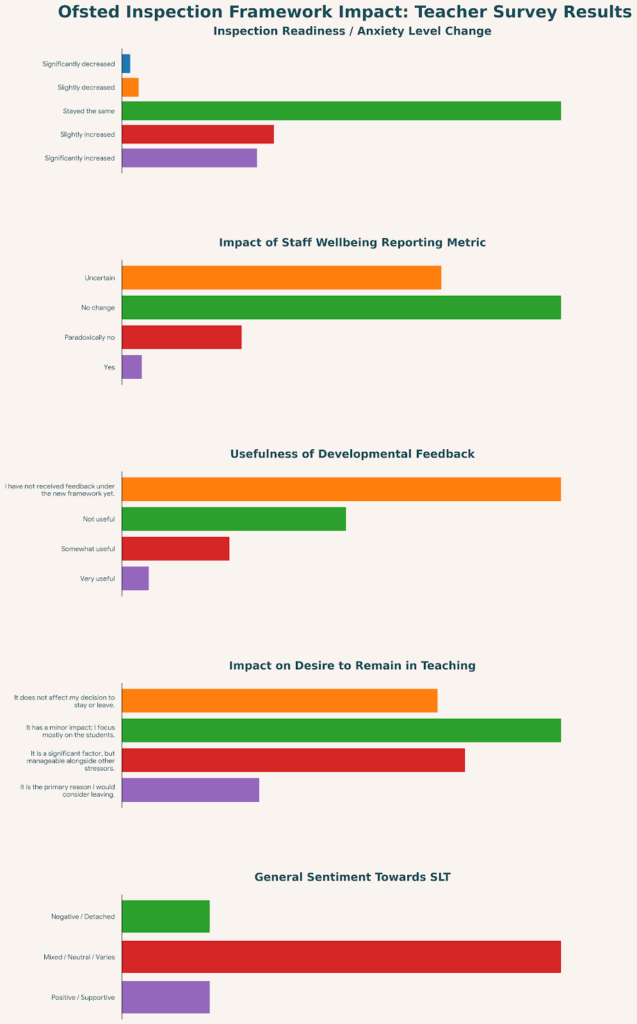
The primary aim of the recent reforms was to replace the reductive ‘Outstanding‘ to ‘Inadequate‘ labels with more nuanced, subject-level feedback. Yet, the data suggests that for many, the change has merely shifted the goalposts rather than lowering the pressure. When asked how their levels of teacher inspection anxiety have changed under the new system, nearly 37% of respondents reported an increase.
For these teachers, the move to more granular report cards often feels like a requirement to be ready in multiple areas simultaneously, rather than focusing on a whole-school narrative. While 45% of our community noted that their anxiety levels have stayed the same, only a small fraction (18%) felt the new system had actually succeeded in making the process less daunting.
The wellbeing metric paradox: Support or surveillance?
One of the most discussed additions to the framework is the mandatory Staff Wellbeing and Retention metric. On paper, this should incentivise leadership teams to prioritise the mental health of their staff. However, our survey findings point to a ‘wellbeing paradox’.
Only 10% of teachers reported a genuine improvement where leadership actively cut performative tasks. In contrast, 44% view the metric as a tick-box exercise for inspectors. Most concerningly, 18% of teachers stated that they are now doing even more work specifically to prove to inspectors that their wellbeing is being looked after. This suggests that the Ofsted reform may be creating a new layer of wellbeing bureaucracy, where the effort to evidence a healthy culture actually contributes to the very intense workload it seeks to reduce.
This lack of genuine impact is further reflected in the feedback process. The new ‘Exacting Standards’ were designed to provide actionable developmental feedback. Yet, of the teachers who have received feedback under this model, a staggering 51% found it either ‘not useful’ or ‘disconnected from the daily reality’ of the classroom.
Conclusion
The survey data highlights a clear disconnect between the policy intentions of the new Ofsted inspection framework and the lived experience of those in the classroom. While the shift away from single-word grades is a step in the right direction, the accountability system remains a dominant factor in professional life. In fact, 81% of our community of teachers identified the current accountability system as either the primary reason or a significant factor in why they would consider leaving the profession.
How has your school adapted its internal observations to meet the new standards? Join the conversation and share your insights in our next weekly survey.
Join the conversation and participate in our next weekly survey.
Join the conversation by participating in next week’s survey to ensure your professional voice shapes the UK education debate.
Our Methodology
About This Survey
All insights published on OnlyForTeachers come directly from teachers across the UK. Each week, we run original surveys on topics that matter most to educators — from classroom practice and workload to wellbeing and policy changes.
Who Takes Part
Participants are active UK teachers who have registered with OnlyForTeachers. Every response remains fully anonymous.
How We Collect Data
Our surveys are designed and distributed weekly through the OnlyForTeachers platform. Questions are short, relevant, and built to capture honest opinions efficiently. Each survey typically runs for one week, and responses are gathered using secure, GDPR-compliant forms.
Data Integrity
We ensure one response per teacher, prevent duplicate entries, and apply basic data cleaning before publishing results. No weighting or external adjustments are made — what you see reflects the real voices of UK teachers.
How We Analyse & Publish
Responses are aggregated and summarised by the OnlyForTeachers research team. Results are published exclusively on our website and social channels and are original to this community. When relevant, we also feature selected teacher comments to add qualitative insights.
Use of Insights
You’re welcome to reference or cite our findings in your articles, research, or policy papers — please credit: “Source: OnlyForTeachers – Original UK Teacher Survey Insights”