
This report is based on original survey data collected directly from UK teachers through the Only for Teachers platform. All insights and findings are unique to our community.
Published: 7 March 2026 | Source: Only for Teachers original survey data
As the spring term progresses, the financial landscape for teachers remains a primary concern for school leaders and the government alike. While recent policy discussions have focused on the 2026/27 pay award, our latest survey paints a complex picture of a profession balancing personal financial stability with the vocational demands of the classroom. The most significant finding from our recent survey is that nearly 30% are now considering leaving the profession within the next three years, with many citing financial pressure as the catalyst.
Financial stability and the teacher cost-of-living crisis
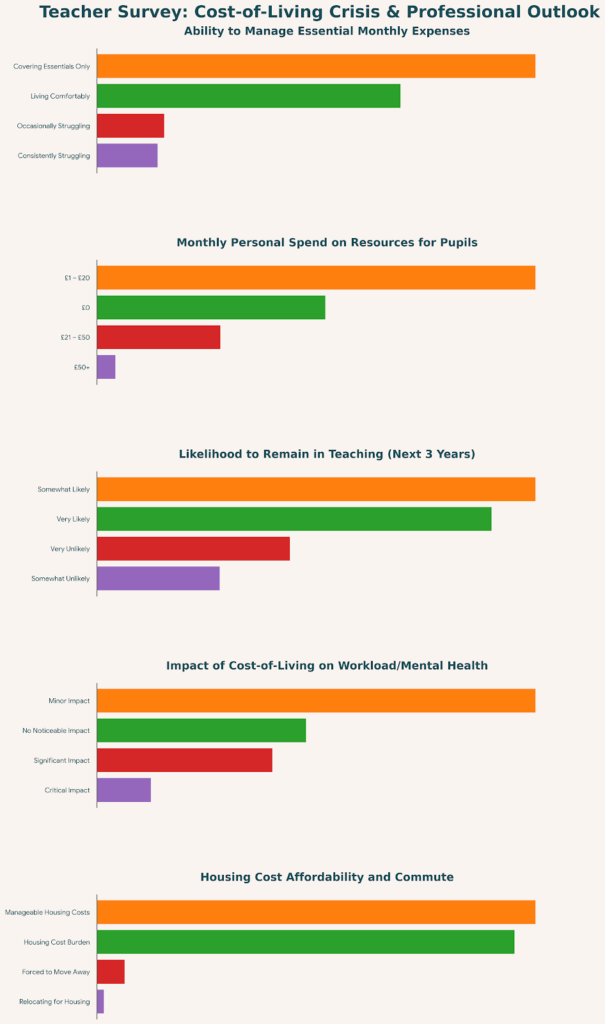
Despite the implementation of several pay adjustments over recent years, the collision of inflation and housing costs continues to put pressure on teacher’s household budgets. Our data indicates that while 34% of teachers report living comfortably, a significant majority are operating on the edge of financial comfort.
Nearly 50% of respondents stated that while they can cover their essential costs, they have been forced to significantly reduce discretionary spending. More concerningly, approximately 15% of teachers are either occasionally struggling to meet essential costs such as rent, utilities, and food, or are consistently relying on credit and external support to manage their monthly outgoings.
The housing market remains a pivotal factor in this trend. For many teachers, the ability to live within a reasonable commuting distance of their school is becoming a luxury. While 48% of our community report manageable housing costs (defined as under 30% of take-home pay), almost 46% described their housing costs as a ‘significant financial burden’. This strain is particularly acute for those in high-cost regions, where the gap between the teacher salary and local rents is widening.
Classroom spending and the impact on teacher retention
The financial pressure on teachers is not confined to their personal lives; it frequently spills over into the classroom. Despite tightening personal budgets, 72% of teachers continue to spend their own money on resources for their pupils. Whether it is providing basic stationery, learning aids, or even food for hungry students, the ‘hidden tax’ on teaching remains a reality.
The majority of those who spend personal funds on their classroom spend between £1 and £20 per month, but for some, the figure is much higher. In an environment where school budgets are stretched thin, teachers often feel a moral obligation to fill the gaps, despite the impact on their own bank balances.
This continued financial drain, combined with the proposed 2026/27 pay award, is having a measurable impact on teacher retention. When asked about their likelihood of remaining in the profession for the next three years, only 34% felt ‘very likely’ to stay. The data highlights the ongoing teacher retention crisis, with 28% of respondents indicating they are ‘unlikely’ to remain. Of these, over half are actively seeking roles outside of education.
This sentiment is echoed in the reports of mental health and workload. While some have seen no impact, a combined 34% of teachers report a ‘significant’ or ‘critical’ impact on their daily workload or mental health due to the cost-of-living crisis. These teachers are often managing increased pupil welfare issues related to poverty or taking on extra duties simply to increase their take-home pay.
Conclusion
This survey highlights that the teacher cost-of-living crisis is more than just a headline; it is a structural challenge affecting teacher mental health and long-term career planning. While the profession remains dedicated to pupil outcomes, the personal financial cost is reaching a tipping point for many.
The apparent conclusion for teachers is the importance of advocating for transparent school resource funding to reduce the reliance on personal contributions. As the 2026/27 pay award discussions continue, it is clear that salary alone is not the only lever; housing affordability and classroom funding are equally critical to keeping talented teachers in the classroom.
We want to hear more about your experiences as the term continues. Please join us and share your views in our next weekly survey.
Join the conversation by participating in next week’s survey to ensure your professional voice shapes the UK education debate.
Our Methodology
About This Survey
All insights published on OnlyForTeachers come directly from teachers across the UK. Each week, we run original surveys on topics that matter most to educators — from classroom practice and workload to wellbeing and policy changes.
Who Takes Part
Participants are active UK teachers who have registered with OnlyForTeachers. Every response remains fully anonymous.
How We Collect Data
Our surveys are designed and distributed weekly through the OnlyForTeachers platform. Questions are short, relevant, and built to capture honest opinions efficiently. Each survey typically runs for one week, and responses are gathered using secure, GDPR-compliant forms.
Data Integrity
We ensure one response per teacher, prevent duplicate entries, and apply basic data cleaning before publishing results. No weighting or external adjustments are made — what you see reflects the real voices of UK teachers.
How We Analyse & Publish
Responses are aggregated and summarised by the OnlyForTeachers research team. Results are published exclusively on our website and social channels and are original to this community. When relevant, we also feature selected teacher comments to add qualitative insights.
Use of Insights
You’re welcome to reference or cite our findings in your articles, research, or policy papers — please credit: “Source: OnlyForTeachers – Original UK Teacher Survey Insights”