
This report is based on original survey data collected directly from UK teachers through the Only for Teachers platform. All insights and findings are unique to our community.
Published: 15 February 2026 | Source: Only for Teachers original survey data
As the Department for Education (DfE) continues to grapple with a persistent recruitment and retention crisis, the focus on how we support the existing workforce has never been more intense. While national strategies often emphasise high-level policy shifts, the day-to-day reality for teachers is often defined by the quality of their professional growth. Our latest survey reveals a clear consensus: the era of static, “tick-box” training is over. Instead, the profession is calling for professional development that is collaborative, practical, and forward-looking, with a significant appetite for technology that actually solves the workload problem.
The collaborative core of effective teaching strategies
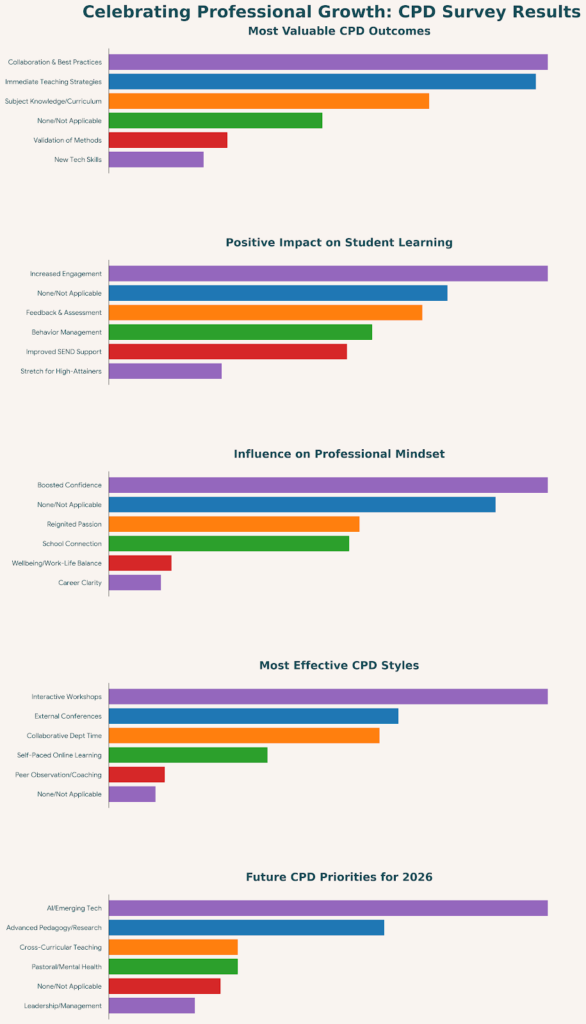
One of the most striking findings from our community is the high value placed on human connection. When asked which specific outcomes from recent CPD for teachers were most valuable, the opportunity to collaborate and share best practices with colleagues (27%) and acquiring concrete, ready-to-use effective teaching strategies (26.3%) emerged as the top priorities.
This data suggests that teachers are moving away from passive learning. The preference for interactive workshops (34.3%) and dedicated departmental time (21.2%) far outweighs the interest in flexible, self-paced online reading (12.4%). This shift reflects a millennial workforce that values community and immediate classroom utility over abstract theory. Furthermore, the impact on students is tangible; 25.5% of teachers reported that recent CPD led directly to increased student engagement and participation.
Future-proofing the classroom with AI in education
Beyond the immediate mechanics of the classroom, there is a burgeoning interest in how emerging technology can reshape the profession. A significant 37.2% of teachers indicated that they are most excited to see AI in education featured on their future CPD calendars, specifically as a means to reduce administrative burden.
This aligns with recent government interest in AI’s potential to automate marking and lesson planning, but the survey results highlight a crucial caveat: teachers want training on these tools, not just the tools themselves. While 30.7% of respondents say that quality CPD has boosted their overall confidence, a notable 27% feel that professional development has had no positive influence on their professional mindset or wellbeing recently. This “confidence gap” underscores the need for training that addresses the modern challenges of the role – namely, using technology to reclaim time rather than adding another layer of digital admin.
Bridging the confidence gap in teacher retention
The link between professional growth and teacher retention is becoming increasingly undeniable. For 30.7% of our community, CPD is a source of confidence and validation. However, the fact that nearly a third of teachers feel professional development is failing to influence their mindset positively is a warning sign for school leaders.
When CPD is perceived as a “drain” rather than an “investment,” it contributes to the burnout cycle. The practitioners in our survey were clear: they want advanced subject-specific guidance (23.4%) and training that supports student wellbeing (10.9%), but they want it delivered in a way that respects their time and professional autonomy. Collaborative planning and hands-on workshops are not just “nice to have”; they are essential for maintaining the passion and enthusiasm that keeps teachers in the classroom.
Conclusion
The data from February 2026 paints a picture of a profession that is ready to evolve. The primary finding is that teachers no longer find value in isolated, top-down training sessions. Instead, they are seeking a professional development ecosystem that prioritises collaboration, practical classroom strategies, and the intelligent application of AI.
The professional takeaway for teachers and school leaders alike is simple: prioritise the “we” over the “I.” Investing in departmental time and interactive, tech-focused training is the most effective way to boost both student outcomes and teacher confidence.
We invite all teachers to share their insights in next week’s survey. Your data is the most powerful tool we have for shaping the future of our profession.
Join the conversation by participating in next week’s survey to ensure your professional voice shapes the UK education debate.
Our Methodology
About This Survey
All insights published on OnlyForTeachers come directly from teachers across the UK. Each week, we run original surveys on topics that matter most to educators — from classroom practice and workload to wellbeing and policy changes.
Who Takes Part
Participants are active UK teachers who have registered with OnlyForTeachers. Every response remains fully anonymous.
How We Collect Data
Our surveys are designed and distributed weekly through the OnlyForTeachers platform. Questions are short, relevant, and built to capture honest opinions efficiently. Each survey typically runs for one week, and responses are gathered using secure, GDPR-compliant forms.
Data Integrity
We ensure one response per teacher, prevent duplicate entries, and apply basic data cleaning before publishing results. No weighting or external adjustments are made — what you see reflects the real voices of UK teachers.
How We Analyse & Publish
Responses are aggregated and summarised by the OnlyForTeachers research team. Results are published exclusively on our website and social channels and are original to this community. When relevant, we also feature selected teacher comments to add qualitative insights.
Use of Insights
You’re welcome to reference or cite our findings in your articles, research, or policy papers — please credit: “Source: OnlyForTeachers – Original UK Teacher Survey Insights”