
This report is based on original survey data collected directly from UK teachers through the Only for Teachers platform. All insights and findings are unique to our community.
Published: 15 February 2026 | Source: Only for Teachers original survey data
As the doors closed on the Excel Centre for another year, the conversation surrounding the future of educational technology remains dominated by a familiar set of themes: artificial intelligence, immersive “gamified” learning, and the digital transformation of the classroom. However, for the teachers working on the front line of UK education, the distance between the Bett 2026 buzz and daily classroom reality remains significant. Our latest survey reveals that while the appetite for innovation is high, particularly in areas that reduce workload, there is a major awareness gap and a set of non-negotiable conditions for adoption that the industry must address.
The attendance gap and the awareness hurdle
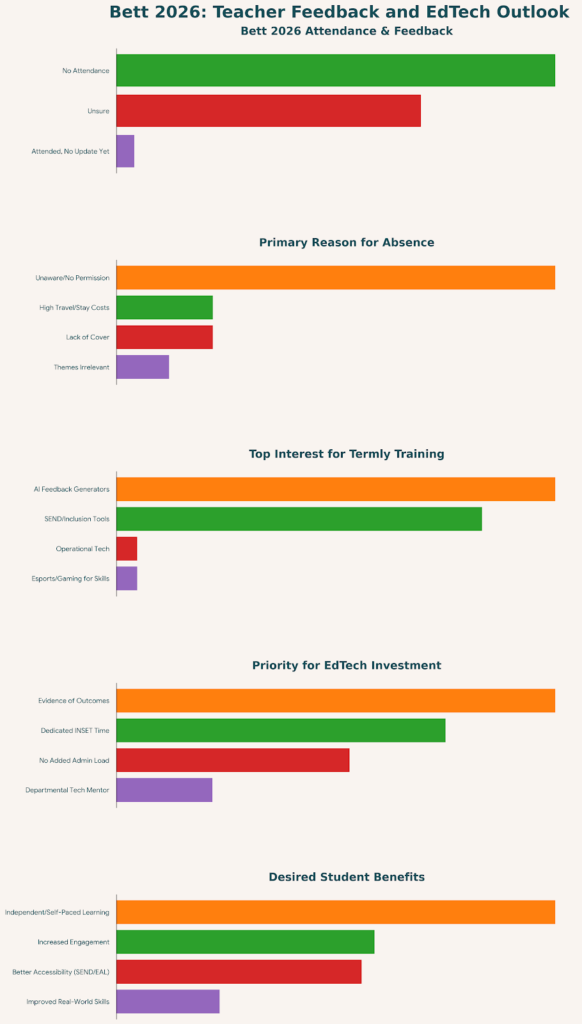
Despite Bett being the flagship event for the sector, the primary takeaway from our community is one of physical and informational distance. An overwhelming 98% of teachers reported that either no one from their department attended the event this year or they were entirely unsure if anyone from their school had made the trip. While travel costs and the perennial issue of cover were cited by 13% of respondents respectively, the most significant barrier was simpler: 59% of teachers were either unaware the event was happening or did not receive permission in time to attend.
This data highlights a growing disconnect. While the Department for Education (DfE) continues to push for a digital-first approach in its long-term strategy, the “buzz” of these major conferences often fails to penetrate the busy staffrooms of schools outside the immediate orbit of the capital.
AI and SEND: The dual pillars of EdTech priorities for teachers
When we look beyond the attendance figures at what teachers actually want to see in their classrooms, the focus shifts sharply toward two specific areas: workload efficiency and inclusion. Interest in training for the coming term is split almost exactly down the middle between AI feedback generators (49%) and new SEND/inclusion tools (48%).
This reflects a clear professional pragmaticism. In a landscape where teacher retention is heavily influenced by administrative burden, tools that can automate the more tedious aspects of marking and feedback are no longer seen as “nice-to-haves” but as essential infrastructure. Similarly, as the number of students with Education, Health and Care (EHC) plans continues to rise across the UK, the demand for SEND inclusion technology—such as live translation and text-to-speech tools—is a top priority for 22% of teachers regarding student benefits.
The conditions for adoption: Evidence over hype
Perhaps the most insightful finding for the EdTech industry is the high bar teachers set for new software. Gone are the days of adopting a tool simply because it is “innovative.” When asked what the most important factor for roll-out would be, 38% of teachers demanded clear evidence that a tool actually improves pupil outcomes. This skepticism toward “fads” is a healthy sign of a mature profession that values pedagogical impact over visual flair.
Furthermore, the logistical reality of the school day remains a gatekeeper for new tech. 28% of teachers stated that they would require dedicated INSET time to learn how to use a tool properly before it is introduced, while 20% would need a guarantee that the software would not add more “hidden” admin to their current workload. Even the desired benefit for students is grounded in independence; 40% of teachers want tech that enables independent, self-paced learning, prioritising student agency over the flashier allure of gamification or VR (which only garnered 24% of the vote).
Conclusion
The data for 2026 suggests that the Bett 2026 buzz only translates into classroom practice when it meets three criteria: it must be accessible, evidence-led, and workload-neutral. The profession is ready to embrace AI in UK schools, but only if the implementation is supported by the time and training necessary to make it work.
The clear professional takeaway for teachers is to remain discerning. As your school considers its next digital investment, use the criteria identified by your peers: demand the evidence of impact and ensure that “innovation” doesn’t come at the cost of your personal time.
We encourage all teachers to share their views in next week’s survey, ensuring your voice contributes to the national conversation.
Join the conversation by participating in next week’s survey to ensure your professional voice shapes the UK education debate.
Our Methodology
About This Survey
All insights published on OnlyForTeachers come directly from teachers across the UK. Each week, we run original surveys on topics that matter most to educators — from classroom practice and workload to wellbeing and policy changes.
Who Takes Part
Participants are active UK teachers who have registered with OnlyForTeachers. Every response remains fully anonymous.
How We Collect Data
Our surveys are designed and distributed weekly through the OnlyForTeachers platform. Questions are short, relevant, and built to capture honest opinions efficiently. Each survey typically runs for one week, and responses are gathered using secure, GDPR-compliant forms.
Data Integrity
We ensure one response per teacher, prevent duplicate entries, and apply basic data cleaning before publishing results. No weighting or external adjustments are made — what you see reflects the real voices of UK teachers.
How We Analyse & Publish
Responses are aggregated and summarised by the OnlyForTeachers research team. Results are published exclusively on our website and social channels and are original to this community. When relevant, we also feature selected teacher comments to add qualitative insights.
Use of Insights
You’re welcome to reference or cite our findings in your articles, research, or policy papers — please credit: “Source: OnlyForTeachers – Original UK Teacher Survey Insights”