
This report is based on original survey data collected directly from UK teachers through the Only for Teachers platform. All insights and findings are unique to our community.
Published: 2 February 2026 | Source: Only for Teachers original survey data
As the 2026 exam season approaches, the focus within UK staffrooms has shifted heavily towards the implementation of evidence-led revision strategies. With the Department for Education (DfE) increasingly emphasising cognitive science – specifically retrieval practice, spacing, and interleaving – the gap between theory and classroom reality is under intense scrutiny. However, our latest survey suggests that while digital revision tools are becoming part of the furniture, a profound “home-school disconnect” is undermining efforts to modernise study habits.
The resilience of traditional methods and digital revision tools
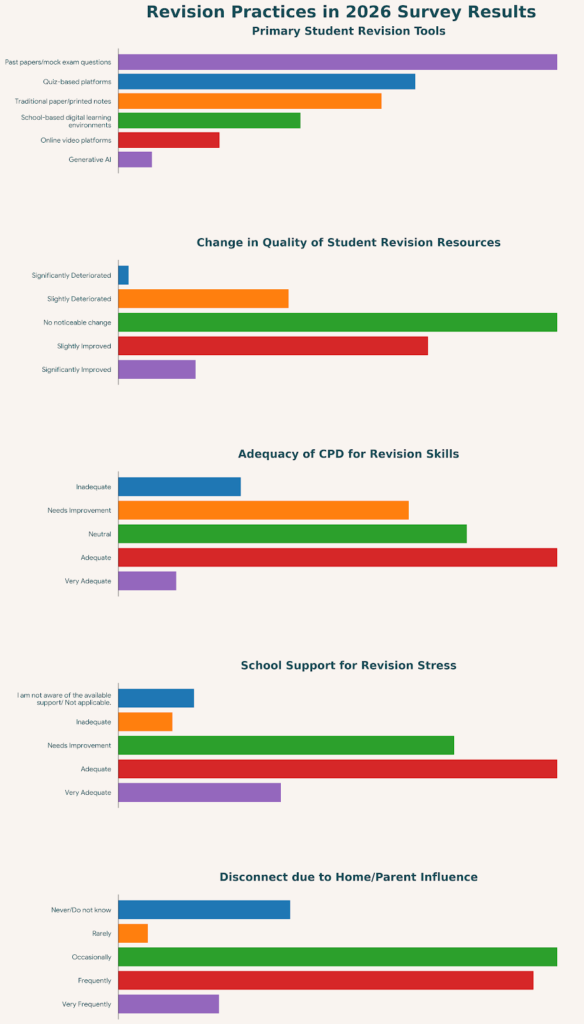
Despite the rapid advancement of educational technology, the staple of the revision diet remains remarkably traditional. According to our data, the single most relied-upon method for independent study is still ‘past papers and mock exam questions’, used by the pupils of 33% of the teachers surveyed. This is closely followed by ‘quiz-based platforms’ at 22.3%, which indicates that while students are moving into digital spaces, they are doing so primarily to engage in testing rather than passive consumption.
The data suggests that the “digital revolution” is being led by active testing rather than generative technologies. Interestingly, only 2.5% of teachers reported that their students primarily rely on generative AI for independent revision. This suggests that while AI is a significant talking point in policy circles, its practical application as a primary study tool remains minimal. Instead, students are balancing high-tech quizzes with ‘traditional paper/printed notes’, which still account for nearly 20% of primary study habits.
Navigating the quality of AI in revision
The rise of AI in revision has sparked concerns regarding the integrity of student-generated resources, such as flashcards and summaries. However, the professional consensus is surprisingly optimistic. When asked how the quality of these resources has changed over the last two years, 43% of teachers noted an improvement (38% ‘Slightly Improved’ and 8% ‘Significantly Improved’).
The majority of respondents (43%) observed no noticeable change, suggesting that AI is currently acting as a digital supplement rather than a transformative force for better or worse. This stability is a testament to the resilience of student study habits, yet it also highlights a potential missed opportunity. If the quality of resources is not significantly deteriorating, the challenge shifts from policing these tools to integrating them into a coherent cognitive science in classrooms framework.
The challenge of parental engagement in education
The most concerning finding from our community is the prevalence of a disconnect between school guidance and home practice. A combined 44% of teachers reported observing a disconnect ‘frequently’ or ‘very frequently’ due to parental influence. In many cases, while schools promote evidence-based techniques like dual coding and retrieval, home environments often default to outdated, passive methods such as highlighting text or re-reading notes – strategies long proven to be less effective.
This lack of alignment is exacerbated by a perceived shortfall in professional preparation. Only 4.5% of teachers feel that the CPD provided by their school or trust is ‘very adequate’ in equipping them to teach these study skills. Furthermore, as student exam stress levels rise, nearly 37% of respondents feel that school-based support for managing revision-related anxiety ‘needs improvement’.
Conclusion and professional takeaway
The 2026 revision landscape is defined by a tension between evidence-based ambition and traditional home habits. While digital revision tools are supporting active recall through quizzes, the fundamental work of shifting student (and parent) mindsets towards more effective cognitive strategies remains unfinished.
The clear professional takeaway for teachers is that the next frontier of revision success is not the tool itself, but parental engagement in education. Bridging the gap requires schools to not only teach students how to study but to actively “upskill” parents on why active retrieval beats passive reading. Without this alignment, the most sophisticated evidence-led revision strategies will continue to stop at the school gates.We urge all teachers to participate in next week’s survey, ensuring the professional voice remains the authoritative source in the national education debate.
Join the conversation by participating in next week’s survey to ensure your professional voice shapes the UK education debate.
Our Methodology
About This Survey
All insights published on OnlyForTeachers come directly from teachers across the UK. Each week, we run original surveys on topics that matter most to educators — from classroom practice and workload to wellbeing and policy changes.
Who Takes Part
Participants are active UK teachers who have registered with OnlyForTeachers. Every response remains fully anonymous.
How We Collect Data
Our surveys are designed and distributed weekly through the OnlyForTeachers platform. Questions are short, relevant, and built to capture honest opinions efficiently. Each survey typically runs for one week, and responses are gathered using secure, GDPR-compliant forms.
Data Integrity
We ensure one response per teacher, prevent duplicate entries, and apply basic data cleaning before publishing results. No weighting or external adjustments are made — what you see reflects the real voices of UK teachers.
How We Analyse & Publish
Responses are aggregated and summarised by the OnlyForTeachers research team. Results are published exclusively on our website and social channels and are original to this community. When relevant, we also feature selected teacher comments to add qualitative insights.
Use of Insights
You’re welcome to reference or cite our findings in your articles, research, or policy papers — please credit: “Source: OnlyForTeachers – Original UK Teacher Survey Insights”