
This report is based on original survey data collected directly from UK teachers through the Only for Teachers platform. All insights and findings are unique to our community.
Published: 24 January 2026 | Source: Only for Teachers original survey data
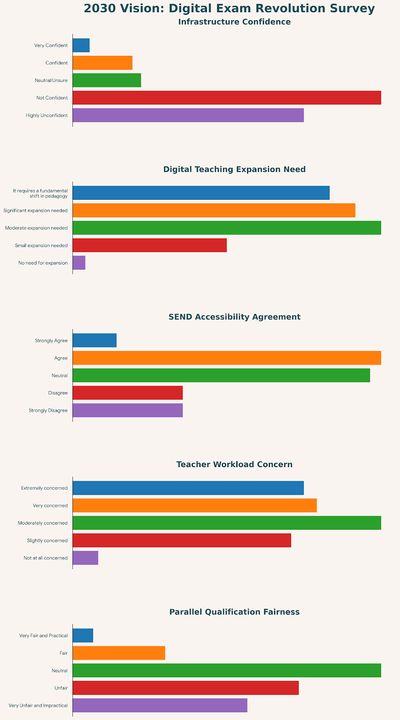
The transition towards a digital-first assessment system remains one of the most ambitious targets in the government’s 2030 vision for English education. As Ofqual continues its extensive consultation on the future of on-screen assessment, and the Department for Education (DfE) signals a clear intention to move away from traditional pen-and-paper models for several GCSE reform subjects, the professional reality on the ground appears significantly detached from policy aspirations. An exclusive survey by Only for Teachers has found a profound lack of confidence amongst practitioners, with 79% of teachers stating they do not feel confident that their schools currently possess the necessary IT infrastructure to deliver large-scale, mandatory digital exams.
The digital divide in school IT infrastructure
The move to digital exams is often discussed in terms of pedagogical benefit and modernising the curriculum, yet our data suggests that the primary barrier is far more pragmatic. The staggering 79% of teachers who are ‘Not Confident’ or ‘Highly Unconfident’ regarding their school’s infrastructure highlights a systemic readiness gap. This figure reflects concerns over device reliability, the suitability of exam hall capacity for on-screen formats, and the resilience of school networks under the pressure of high-stakes testing windows.
Without a significant national investment in school IT infrastructure, the 2030 deadline for the digital revolution risks being met with technical failure or local exclusion. This is not merely an equipment issue; 57% of teachers also believe their specific subjects require a moderate to significant expansion of digital teaching just to prepare students for the basic requirements of on-screen navigation.
Accessibility and the burden on teacher workload
One of the central arguments for on-screen assessment is its potential to improve outcomes for students with Special Educational Needs and Disabilities (SEND). Adaptive technologies, such as text-to-speech or customisable interfaces, could theoretically remove barriers. However, our community remains split on this promise: only 40% of teachers agree that a move to digital formats would genuinely improve the assessment experience for their SEND pupils.
This scepticism is closely tied to the perceived impact on the profession. 46% of teachers reported being ‘Very’ or ‘Extremely Concerned’ about the potential increase in teacher workload and technical burden. The transition requires not just new training, but the massive task of adapting resources and managing the inevitable technical disruptions that arise during trial phases. For many, the transition feels like an additional administrative layer placed upon an already stretched workforce.
Fairness in the Ofqual digital consultation model
The current strategy involves offering parallel on-screen and paper versions as separate qualifications in the initial stages. This ‘twin-track’ approach aims to mitigate the risk of technical failure, but it raises significant questions about equity. According to our data, 49% of teachers believe that offering two parallel qualifications for the same subject is an unfair or impractical approach.
Concerns primarily centre on the potential for a two-tier system, where students in well-resourced schools benefit from modern digital features while those in schools with failing infrastructure are left with traditional models. If the qualifications are not perceived as perfectly equivalent, it could lead to further disparity in student outcomes – a concern that must be central to any Ofqual digital consultation moving forward.
Conclusion and takeaway
The survey results represent a clear warning from the profession: the vision for digital exams is currently outstripping the capacity of the system to deliver them. While the opportunities are recognised by some, the infrastructure deficit and the threat to teacher workload are the dominant professional concerns.
The clear takeaway for teachers is that while the digital revolution is coming, the profession must remain vocal about the necessity for ring-fenced infrastructure funding. Policy success in 2030 will not be measured by the sophistication of the software, but by the reliability of the hardware and the support given to those administering the tests.
We urge all teachers to participate in next week’s survey, ensuring the professional voice remains the authoritative source in the national education debate.
Join the conversation by participating in next week’s survey to ensure your professional voice shapes the UK education debate.
Our Methodology
About This Survey
All insights published on OnlyForTeachers come directly from teachers across the UK. Each week, we run original surveys on topics that matter most to educators — from classroom practice and workload to wellbeing and policy changes.
Who Takes Part
Participants are active UK teachers who have registered with OnlyForTeachers. Every response remains fully anonymous.
How We Collect Data
Our surveys are designed and distributed weekly through the OnlyForTeachers platform. Questions are short, relevant, and built to capture honest opinions efficiently. Each survey typically runs for one week, and responses are gathered using secure, GDPR-compliant forms.
Data Integrity
We ensure one response per teacher, prevent duplicate entries, and apply basic data cleaning before publishing results. No weighting or external adjustments are made — what you see reflects the real voices of UK teachers.
How We Analyse & Publish
Responses are aggregated and summarised by the OnlyForTeachers research team. Results are published exclusively on our website and social channels and are original to this community. When relevant, we also feature selected teacher comments to add qualitative insights.
Use of Insights
You’re welcome to reference or cite our findings in your articles, research, or policy papers — please credit: “Source: OnlyForTeachers – Original UK Teacher Survey Insights”