
This report is based on original survey data collected directly from UK teachers through the Only for Teachers platform. All insights and findings are unique to our community.
Published: 12 December 2025 | Source: Only for Teachers original survey data
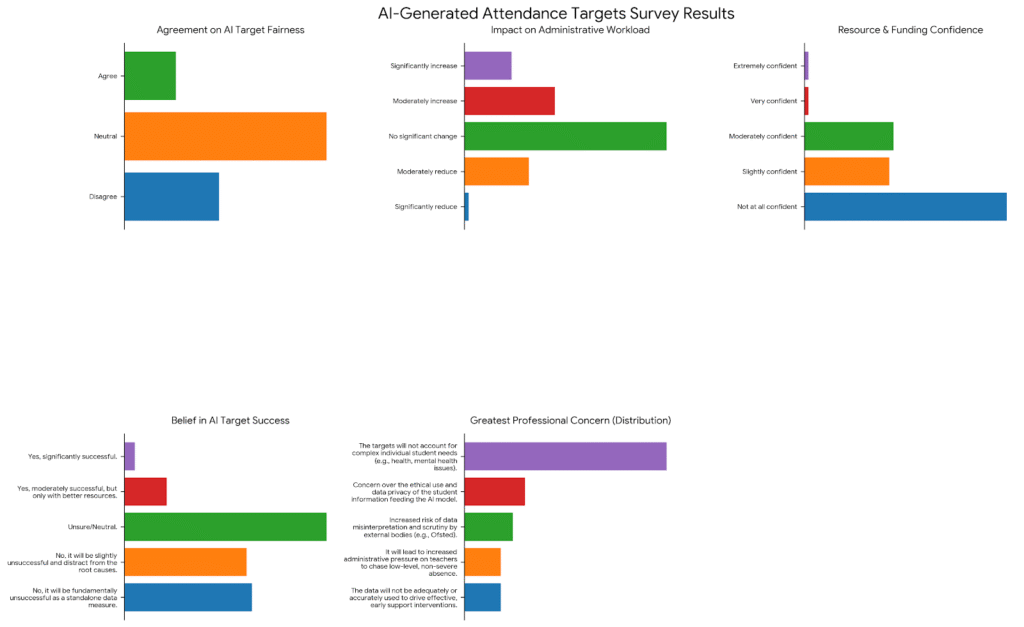
The Department for Education (DfE) is implementing a new mechanism this academic year, using Artificial Intelligence (AI) to generate mandatory minimum pupil attendance targets that schools in England must achieve in a renewed effort to reduce persistent pupil absence. This policy represents a significant escalation of data-driven accountability. While the ambition to address the UK’s attendance crisis is broadly shared, an exclusive survey conducted by Only for Teachers reveals profound scepticism within the profession regarding the policy’s feasibility and resourcing. The most critical finding highlights a potential delivery crisis: a staggering 74% of teachers reported being ‘Not at all confident’ or ‘Slightly confident’ that their school has the necessary resources (e.g., dedicated staff time, funding for early intervention) to effectively meet these mandatory AI-generated targets.
The resource deficit and the workload risk
The confidence gap exposed by this data suggests that the DfE’s focus on data metrics is fundamentally decoupled from the material reality of schools on the ground. Setting an AI attendance target is a technological solution, but the execution of the necessary interventions to meet that target remains a human, resourced challenge.
This lack of confidence in resources is exacerbated by genuine fears that the new policy will actively undermine the concurrent DfE objective of reducing teacher workload. Despite the technology’s promise of streamlining data analysis, 35% of teachers anticipate that the implementation of AI-generated targets will ‘Moderately increase’ or ‘Significantly increase’ their overall administrative workload related to attendance monitoring and reporting. This reinforces the professional suspicion that new accountability measures, however technologically advanced, often translate into added pressure and bureaucracy for already stretched staff.
Professional concern: The human element
When asked about their greatest professional concern regarding the increased policy focus on mandatory AI attendance targets, the response was overwhelmingly focused on the limitations of the data model itself.
The leading concern, selected by 51% of teachers, was that the ‘Targets will not account for complex individual student needs (e.g., health, mental health issues)’. This underscores the professional belief that algorithms, while powerful for aggregation, cannot replace the contextual nuance required to understand and address the underlying drivers of severe pupil absence.This fear that the human element will be lost in the drive for data compliance is further reflected in the sentiment regarding the fairness of the metrics. A significant 49% of teachers were ‘Neutral’ (49%) or ‘Disagree/Strongly Disagree’ (23%) that the targets would be fairer, more accurate, and contextually relevant for their school. This lack of clear confidence suggests that the profession is not yet convinced the AI model can adequately address the highly varied socio-economic and demographic contexts across England.
Conclusion and professional takeaway
The findings of this survey provide an authoritative assessment of the profession’s immediate reaction to the new AI attendance targets. The data delivers a clear warning: a new accountability measure reliant on technology cannot succeed if the human, financial, and administrative resources needed to operationalise the policy are deemed insufficient by three-quarters of the workforce.
The core takeaway for policymakers is that the success of the DfE’s renewed drive to tackle pupil absence hinges less on the sophistication of the AI model and more on the commitment to adequately fund the front-line staff required for early intervention. For teachers, the priority must be to rigorously document instances where the mandatory targets fail to align with complex student needs, ensuring that the limits of the data-driven approach are objectively and professionally communicated to school leadership and governing bodies.
We urge all teachers to participate in next week’s survey, ensuring the professional voice remains the authoritative source in the national education debate.
Join the conversation by participating in next week’s survey to ensure your professional voice shapes the UK education debate.
Our Methodology
About This Survey
All insights published on OnlyForTeachers come directly from teachers across the UK. Each week, we run original surveys on topics that matter most to educators — from classroom practice and workload to wellbeing and policy changes.
Who Takes Part
Participants are active UK teachers who have registered with OnlyForTeachers. Every response remains fully anonymous.
How We Collect Data
Our surveys are designed and distributed weekly through the OnlyForTeachers platform. Questions are short, relevant, and built to capture honest opinions efficiently. Each survey typically runs for one week, and responses are gathered using secure, GDPR-compliant forms.
Data Integrity
We ensure one response per teacher, prevent duplicate entries, and apply basic data cleaning before publishing results. No weighting or external adjustments are made — what you see reflects the real voices of UK teachers.
How We Analyse & Publish
Responses are aggregated and summarised by the OnlyForTeachers research team. Results are published exclusively on our website and social channels and are original to this community. When relevant, we also feature selected teacher comments to add qualitative insights.
Use of Insights
You’re welcome to reference or cite our findings in your articles, research, or policy papers — please credit: “Source: OnlyForTeachers – Original UK Teacher Survey Insights”