
The landscape of teacher professional development (CPD) in the UK has never been under such intense scrutiny. With the Department for Education (DfE) heavily invested in establishing a ‘golden thread’ of evidence-based training—from the Early Career Framework (ECF) to the National Professional Qualifications (NPQs)—the expectation for high-quality, impactful CPD is non-negotiable. However, this formal drive must align with the practical realities of a time-pressured workforce.
Original survey data collected directly from teachers on the OnlyForTeachers platform provides crucial insight into this tension, confirming a clear preference for a modern, hybrid model. The most significant finding is that a blended approach (mix of in-person and online) is now the most desired format for professional learning, a clear sign that teachers are actively seeking to synthesise the best aspects of both worlds.
Blended CPD and the collaboration imperative
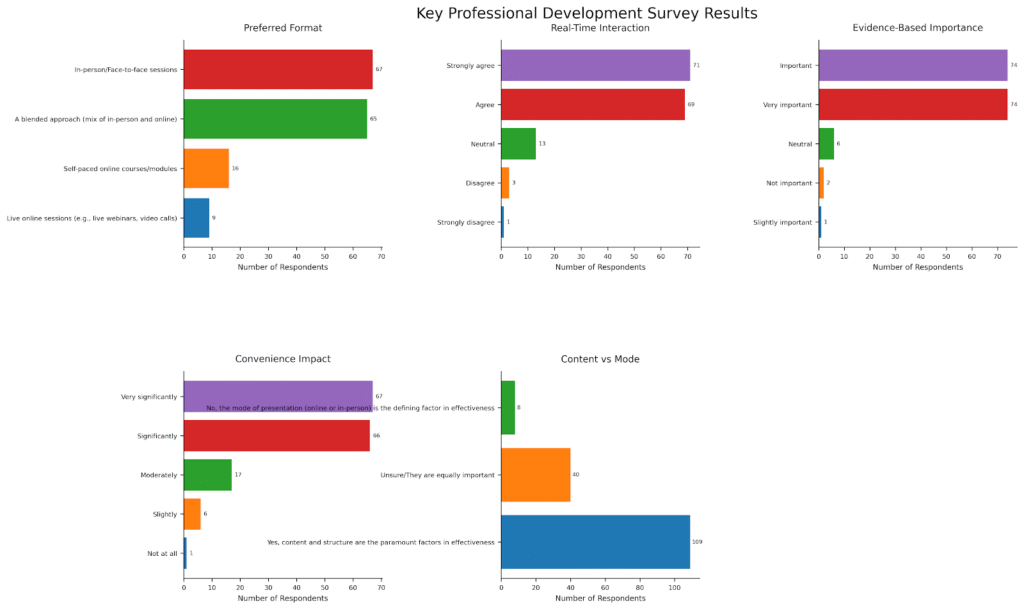
In a survey of over $1,100$ teachers, $38.8\%$ stated their preference for a blended CPD model. This is a narrow but significant plurality over the traditional in-person training model, which was favoured by $35.9\%$ of respondents. Self-paced online courses, while offering maximum flexibility, were the least popular option, preferred by just $25.3\%$ of the teaching community.
This trend is not simply about format; it is driven by a deep-seated professional need. Of those who responded to follow-up questions, an overwhelming $89.6\%$ strongly agreed or agreed that real-time interaction and collaboration with colleagues or facilitators is a crucial element of effective professional development. This statistic highlights why completely isolating, asynchronous online modules fall short—the profession values the shared intellectual challenge and support that structured, collaborative settings provide.
[INSERT CHART/GRAPH: Teacher CPD format preference breakdown by percentage, Pie or Bar Chart]
| Format | Responses | Percentage |
| Blended Approach | 452 | 38.8% |
| In-person/Face-to-face | 418 | 35.9% |
| Self-paced online courses | 294 | 25.3% |
The preference for blended learning thus emerges as the practical solution for high-quality teacher collaboration. It allows schools to maintain the vital face-to-face element—a key requirement of the DfE’s ‘Standard for teachers’ professional development’—while incorporating the undeniable benefits of digital delivery.
Balancing convenience with content quality
While teachers clearly value real-world interaction, the survey data also confirms that the practicality of online learning is a powerful incentive for engagement. Approximately $84.7\%$ of respondents stated that the convenience and flexibility (in timing and location) of online professional development increased their likelihood of participation significantly or very significantly. This is a direct reflection of the persistent pressures on teacher workload and the challenge of securing cover for in-person attendance.
However, convenience is not mistaken for quality. When asked to weigh the factors, a substantial $68.3\%$ of teachers believed that the effectiveness of professional development is defined more by the quality and structure of the content than by the mode of presentation. This perspective supports the core intention of the DfE’s reforms, which seek to ensure all CPD is robustly evidenced and focused on practical, high-impact teaching methods.
The data suggests that the teaching profession is sophisticated enough to demand both rigorous content and pragmatic delivery. In-person training is often seen as the gold standard for collaboration, but the flexibility of the blended CPD model allows teachers to engage with essential learning without it becoming another unsustainable pressure on their non-contact time.
Conclusion and professional takeaway
The findings of this report send a clear message to policymakers and CPD providers: the future of teacher professional development is hybrid. Teachers are not rejecting online learning; rather, they are using their experience to define a model that delivers the necessary social and collaborative rigour alongside essential flexibility.
For teachers, the takeaway is an affirmation: your demand for impactful, relevant, and convenient training is justified. As political discussion continues around a formal CPD entitlement, the data shows that a blended approach is the most effective synthesis of best practice and professional reality. It is a model that school leaders should prioritise as they structure their internal professional learning offer.
Join the conversation by participating in next week’s survey to ensure your professional voice shapes the UK education debate.
Our Methodology
About This Survey
All insights published on OnlyForTeachers come directly from teachers across the UK. Each week, we run original surveys on topics that matter most to educators — from classroom practice and workload to wellbeing and policy changes.
Who Takes Part
Participants are active UK teachers who have registered with OnlyForTeachers. Every response remains fully anonymous.
How We Collect Data
Our surveys are designed and distributed weekly through the OnlyForTeachers platform. Questions are short, relevant, and built to capture honest opinions efficiently. Each survey typically runs for one week, and responses are gathered using secure, GDPR-compliant forms.
Data Integrity
We ensure one response per teacher, prevent duplicate entries, and apply basic data cleaning before publishing results. No weighting or external adjustments are made — what you see reflects the real voices of UK teachers.
How We Analyse & Publish
Responses are aggregated and summarised by the OnlyForTeachers research team. Results are published exclusively on our website and social channels and are original to this community. When relevant, we also feature selected teacher comments to add qualitative insights.
Use of Insights
You’re welcome to reference or cite our findings in your articles, research, or policy papers — please credit: “Source: OnlyForTeachers – Original UK Teacher Survey Insights”