
This report is based on original teacher survey data collected directly from UK teachers through the Only for Teachers platform. All insights and findings are unique to our community.
Published: November 2025 | Source: Only for Teachers original survey data
The quality of education fundamentally relies on the quality of the resources available to teachers and pupils. Yet, as school budget cuts in the UK continue to bite, the simple act of acquiring necessary teaching tools has become a major source of friction. The financial landscape requires stringent fiscal management, but for teachers on the front line, the formal procedures designed for cost control often act as obstacles to effective teaching. An exclusive survey conducted by Only for Teachers exposes the extent of this bureaucratic frustration, confirming that the school procurement process is now a significant impediment to professional agility. The most impactful finding reveals a fundamental lack of confidence in school systems: 60% of teachers agree or strongly agree that the formal purchasing process is a significant barrier to getting new resources into the classroom quickly.
The school procurement process as a significant budget barrier
In an environment where teachers are under constant scrutiny to demonstrate impact and accelerate pupil progress, delays in resource acquisition are not merely irritating; they undermine professional efficacy. The overwhelming consensus that the current school procurement process is a barrier, highlights a systemic failure to balance fiscal responsibility with pedagogical need.
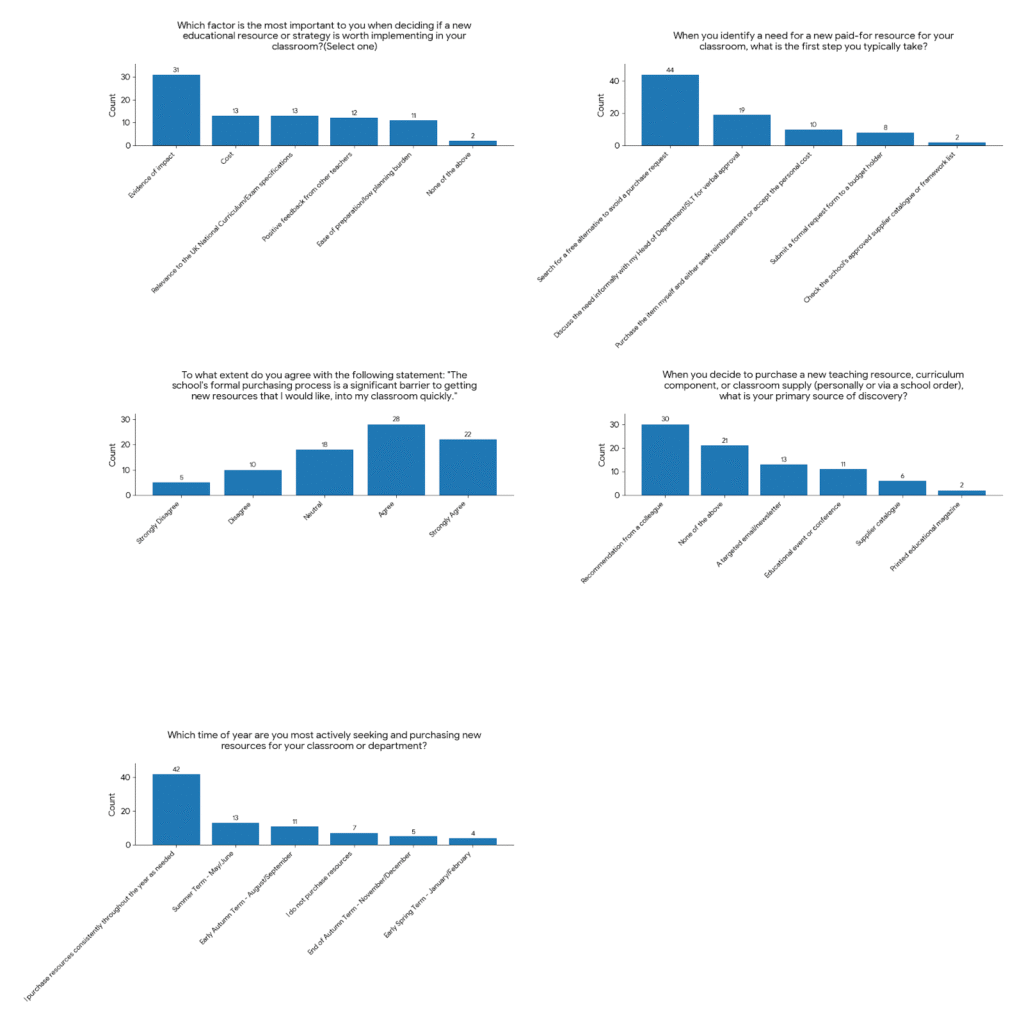
For school leaders wrestling with rising costs – particularly energy bills and increased SEND demands – tightening the purse strings is a necessity. However, when 60% of the workforce feels professionally hampered by the system intended to support them, the process itself becomes counterproductive, potentially costing more in lost time and missed learning opportunities than it saves in expenditure.
Furthermore, this barrier is leading to a significant professional compromise: a notable 12% of teachers report that their first step when identifying a need for a paid-for resource is to ‘Purchase the item myself and either seek reimbursement or accept the personal cost’. This widespread self-subsidisation of the state system is a clear and objective indicator of deep procedural dysfunction and places an unfair financial burden on the very professionals the government aims to support through the Workload Reduction Taskforce.
The impact of budget barriers on teacher resource acquisition
The procurement hurdle is fundamentally reshaping how teachers approach resource planning, prioritisation, and teacher resource acquisition. The data shows that the primary motivation for implementation is driven by pedagogical necessity, not cost, yet the first tactical response to the barrier is to seek a workaround based on budget.
When deciding if a new resource is worth implementing, the top factor for 37.8% of teachers is ‘Evidence of impact’. This is more than double the proportion who prioritise ‘Cost’ or ‘Relevance to the UK National Curriculum/Exam specifications’ (both at 15.9%). This confirms that teachers are intrinsically motivated by what works, focusing on strategies that deliver tangible educational benefits.
However, the pressure of budget barriers forces a practical compromise. Our survey found that the most common first step taken by teachers (a majority of 53%) when identifying a need for a paid resource is to ‘Search for a free alternative to avoid a purchase request’. While resourceful, this strategy imposes a hidden, unquantified cost on teacher workload. Instead of using proven, quality-assured materials, teachers spend valuable time vetting, adapting, or creating free alternatives, directly contradicting the DfE’s objective to minimise administrative burden and address the teacher retention crisis. The time spent on procurement workarounds is time taken away from quality teaching, planning, or wellbeing.
Conclusion and professional takeaway
This exclusive data provides an objective audit of the current resource landscape: the school procurement process is failing the professionals that it is meant to serve, acting as a bureaucratic chokehold on effective teaching and leading to significant, unsung personal expenditure and workload increases for teachers.
The core takeaway must be an urgent review of current purchasing policies. The data suggests that if policymakers wish to genuinely address teacher retention and workload, they must dismantle the budget barriers that force professionals to compromise their pedagogical standards or personally subsidise the state system. Processes must be streamlined to match the speed and agility required for high-impact teaching, ensuring that when teachers identify a resource with clear evidence of impact, they can secure it with minimal friction.
We urge all teachers to participate in next week’s survey, ensuring the professional voice remains the authoritative source in the national education debate.
Our Methodology
About This Survey
All insights published on OnlyForTeachers come directly from teachers across the UK. Each week, we run original surveys on topics that matter most to educators — from classroom practice and workload to wellbeing and policy changes.
Who Takes Part
Participants are active UK teachers who have registered with OnlyForTeachers. Every response remains fully anonymous.
How We Collect Data
Our surveys are designed and distributed weekly through the OnlyForTeachers platform. Questions are short, relevant, and built to capture honest opinions efficiently. Each survey typically runs for one week, and responses are gathered using secure, GDPR-compliant forms.
Data Integrity
We ensure one response per teacher, prevent duplicate entries, and apply basic data cleaning before publishing results. No weighting or external adjustments are made — what you see reflects the real voices of UK teachers.
How We Analyse & Publish
Responses are aggregated and summarised by the OnlyForTeachers research team. Results are published exclusively on our website and social channels and are original to this community. When relevant, we also feature selected teacher comments to add qualitative insights.
Use of Insights
You’re welcome to reference or cite our findings in your articles, research, or policy papers — please credit: “Source: OnlyForTeachers – Original UK Teacher Survey Insights”