
This report is based on original teacher survey data collected directly from UK teachers through the OnlyForTeachers platform. All insights and findings are unique to our community.
Published: Nov 2025 | Source: OnlyForTeachers original survey data
This report is based on original survey data collected directly from UK teachers through the Only for Teachers platform. All insights and findings are unique to our community. Published: 28 October 2025 | Source: OnlyForTeachers original survey data
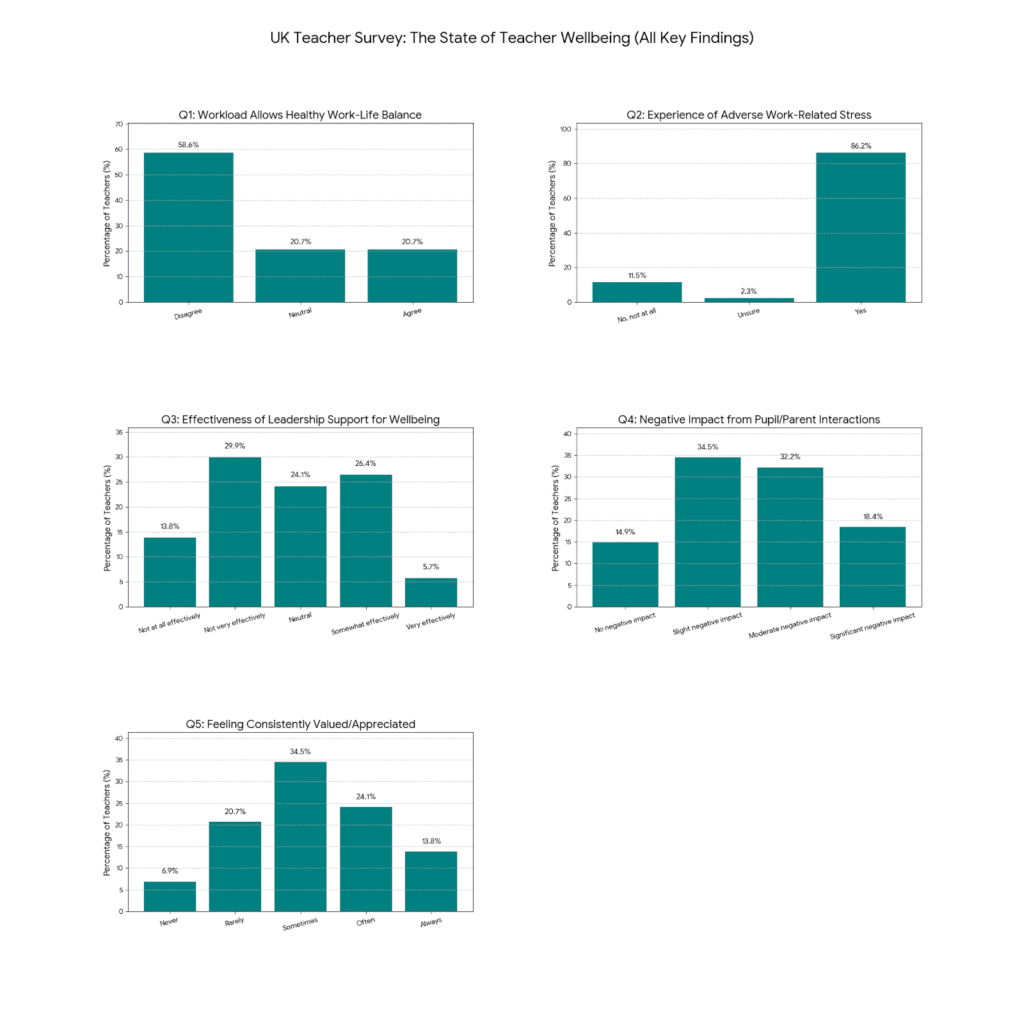
The teacher retention crisis remains one of the most pressing challenges in UK education policy. While the Workload Reduction Taskforce seeks to alleviate administrative pressures, the persistent erosion of personal time and the emotional toll of the job continue to hollow out the profession. An exclusive survey conducted by Only for Teachers provides an authoritative and objective assessment of the true state of teacher wellbeing in the UK, revealing a stark reality: the vast majority of teachers do not have a sustainable career. The most alarming finding is the widespread absence of a healthy boundary between work and personal life, with a resounding 71% of teachers stating they disagree or strongly disagree that their current workload allows them to maintain a healthy work-life balance.
The systemic breakdown of work-life balance
This consensus on unmanageable hours suggests that the current system is structurally reliant on the goodwill and sacrifice of its workforce. For teachers, the failure to achieve work-life balance is not merely an inconvenience; it translates directly into significant mental strain.
The survey data confirms this alarming correlation. When asked if they had experienced work-related stress that adversely affected their mental health (e.g., increased anxiety, sleep loss, burnout) in the past academic year, a substantial 67% of teachers reported a moderate or significant impact. This level of sustained professional stress is unsustainable and provides the clearest possible explanation for the chronic drain on talent from state schools.
The professional reality painted by these figures is one where the very act of maintaining a teaching career places a majority of teachers at risk of burnout. Until the government’s effort, including the Workload Reduction Taskforce, translates into a meaningful reduction of non-contact time tasks, this fundamental issue underpinning poor teacher wellbeing will persist.
The compounding impact of behaviour, parents, and feeling undervalued
Beyond the excessive hours, a combination of difficult professional interactions and a lack of institutional support are compounding the work-related stress. The emotional demands placed upon teachers—managing increasingly complex behaviour and navigating challenging parental interactions—are a significant burden.
A striking 79% of teachers reported that challenging pupil behaviour or difficult interactions with parents/guardians had negatively impacted their personal wellbeing in the last 12 months. This high figure highlights that the pressure on teachers is not solely administrative; it is interpersonal and emotional, reflecting broader societal strain that the school system is forced to absorb.
Crucially, this stress is often managed without adequate institutional recognition or support. When asked about their school’s environment, only 22% of teachers felt consistently valued and appreciated for their contributions within their school community (‘Always’ or ‘Often’). Furthermore, a significant 48% stated that their school leadership provided support for staff mental health either ‘Not very effectively’ or ‘Not at all effectively’.
This triple threat—unsustainable workload, challenging daily interactions, and a prevailing lack of feeling valued—creates a toxic environment that actively fuels the teacher retention crisis. It suggests that many teachers are suffering in silence and feeling unsupported by the very systems meant to care for their professional safety and longevity.
Conclusion and professional takeaway
This exclusive data provides an objective, teacher-led diagnosis: the majority of teachers are operating under conditions of chronic work-related stress and unacceptable work-life balance. This situation is not merely uncomfortable; it is the structural mechanism driving qualified professionals out of state education.
The core takeaway for the sector and policymakers must be a decisive shift in priorities. Efforts to address the teacher retention crisis will fail until these not-so-surprising findings are acknowledged and addressed with radical action, including systemic workload limits and mandatory, well-resourced staff mental health support structures. The data clearly demonstrates that the current level of professional pressure is unsustainable and requires urgent government and school leadership intervention.
We urge all teachers to participate in next week’s survey, ensuring the professional voice remains the authoritative source in the national education debate.
Our Methodology
About This Survey
All insights published on OnlyForTeachers come directly from teachers across the UK. Each week, we run original surveys on topics that matter most to educators — from classroom practice and workload to wellbeing and policy changes.
Who Takes Part
Participants are active UK teachers who have registered with OnlyForTeachers. Every response remains fully anonymous.
How We Collect Data
Our surveys are designed and distributed weekly through the OnlyForTeachers platform. Questions are short, relevant, and built to capture honest opinions efficiently. Each survey typically runs for one week, and responses are gathered using secure, GDPR-compliant forms.
Data Integrity
We ensure one response per teacher, prevent duplicate entries, and apply basic data cleaning before publishing results. No weighting or external adjustments are made — what you see reflects the real voices of UK teachers.
How We Analyse & Publish
Responses are aggregated and summarised by the OnlyForTeachers research team. Results are published exclusively on our website and social channels and are original to this community. When relevant, we also feature selected teacher comments to add qualitative insights.
Use of Insights
You’re welcome to reference or cite our findings in your articles, research, or policy papers — please credit: “Source: OnlyForTeachers – Original UK Teacher Survey Insights”