
This report is based on original teacher survey data collected directly from UK teachers through the Only for Teachers platform. All insights and findings are unique to our community.
Published: Oct 2025 | Source: Only for Teachers original survey data
This report is based on original survey data collected directly from UK teachers through the Only for Teachers platform. All insights and findings are unique to our community. Published: 19 October 2025 | Source: Only for Teachers original survey data
The integration of Artificial Intelligence (AI) into the classroom has moved rapidly from a futuristic concept to a practical policy consideration. With the government’s Workload Reduction Taskforce aiming to alleviate the administrative pressures driving the ongoing teacher retention crisis, many view AI as a vital tool to automate mundane tasks. An exclusive survey of UK teachers by Only for Teachers confirms this professional optimism, yet simultaneously exposes critical systemic weaknesses regarding the implementation and ethical oversight of this new technology. While the majority of teachers see AI as the key to significant teacher workload reduction, they report a profound lack of support and harbour deep ethical concerns, suggesting that the path to effective, widespread adoption is far from clear.
The promise of lesson planning automation and administrative relief
The potential for AI to automate routine administration—from drafting lesson plans and creating differentiated resources to generating report card comments—is clearly understood by those on the front line. Our data reveals a strong belief in the technology’s ability to free up valuable professional time.
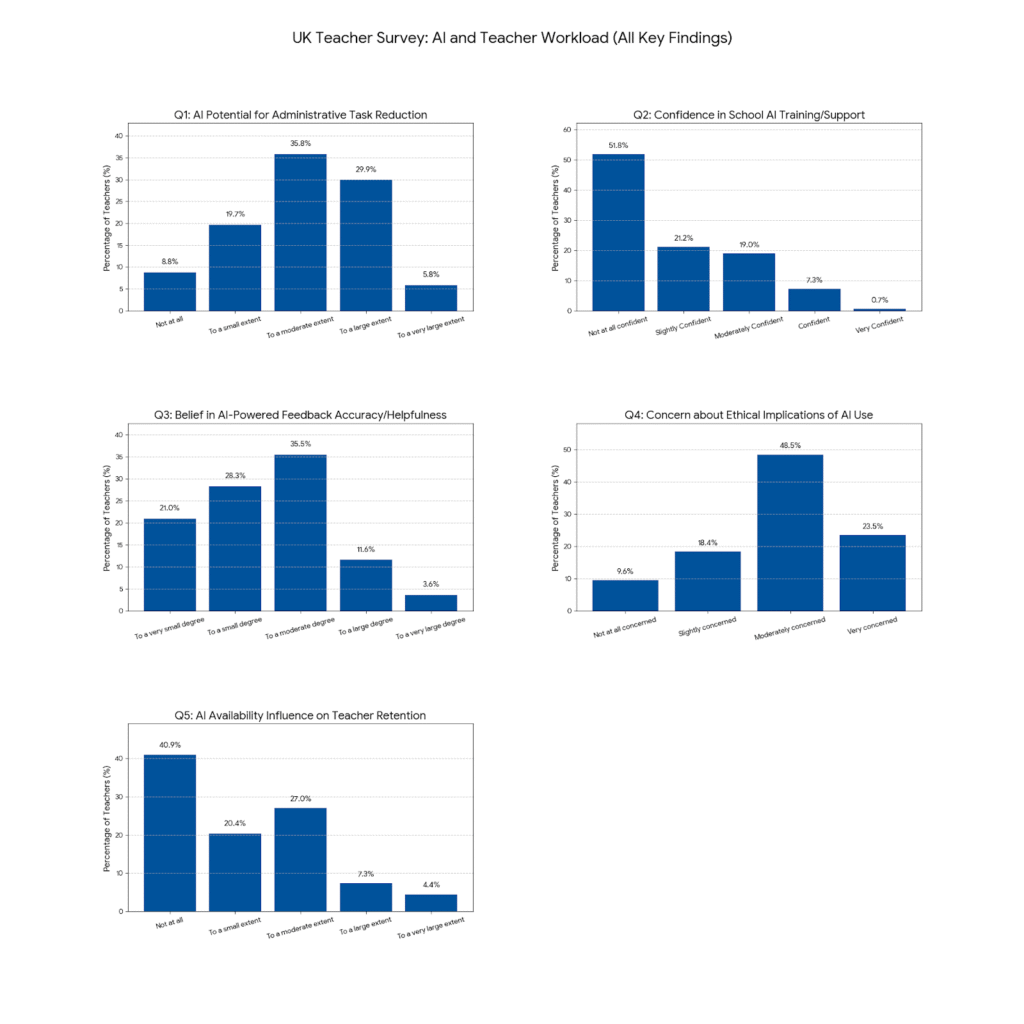
In fact, 65% of teachers stated that they believe AI tools have the potential to reduce time spent on administrative tasks to a ‘Large’ or ‘Very large’ extent. This optimism is a clear signal to policymakers that teachers are ready to embrace digital solutions if they genuinely translate into time savings. This figure directly supports the mission of the DfE’s Workload Reduction Taskforce by confirming that the workforce itself is identifying technology as a high-impact solution to excessive hours.
However, the widespread adoption necessary to achieve this mass teacher workload reduction hinges on trust and effective deployment, areas where school provision is currently falling short.
Barriers to adoption: training, ethics, and the teacher retention crisis
Despite the appetite for automation, the professional landscape is currently defined by uncertainty. When questioned about the support they receive, a substantial majority of teachers reported a lack of confidence in their current provision.
A staggering 78% of teachers reported being ‘Not at all confident’ or only ‘Slightly confident’ in their school’s current provision of training and support for effectively using AI tools to manage their workload. This massive confidence deficit indicates a failure of infrastructure and investment at the local and national level, threatening to turn this opportunity for teacher workload reduction into yet another source of frustration.
Crucially, this technological transition is shadowed by significant ethical anxiety. Given the recent national spotlight on data security and digital literacy, the lack of clear guidance on ethical AI in education is deeply concerning for the profession.
A remarkable 74% of teachers are ‘Concerned’ or ‘Very concerned’ about the ethical implications—such as data privacy, bias in resource generation, and the impact on essential human interaction—of using AI tools in a UK school setting.
The dual challenge of the lack of training and high ethical concern, poses a tangible threat to the government’s aim to address the teacher retention crisis. Our survey found that 51% of teachers stated the availability of reliable and easy-to-use AI tools would influence their decision to remain in the profession to a ‘Moderate’ or ‘Very large’ extent. For half of the teaching workforce, technology is now explicitly tied to career viability. If the tools are unreliable, unsupported, or ethically dubious, they will actively worsen, rather than solve, the retention problem.
Conclusion and professional takeaway
The core finding of this survey is a moment of profound clarity for UK education policy: teachers overwhelmingly recognise AI as a solution to chronic workload, but their professional enthusiasm is being dampened by an unready system. There is a disconnect between the potential benefits of lesson planning automation and the operational reality in schools.
The primary takeaway for the sector must be a firm focus on governance and investment. The onus is on the Department for Education, school trusts, and senior leadership to move beyond pilot projects and deliver systematic, mandatory, and high-quality training. Furthermore, clear, enforceable, and transparent national guidance on Ethical AI in Education must be swiftly published and integrated into professional standards, reassuring teachers that these powerful tools can be deployed safely and equitably. Without this decisive systemic action, AI risks becoming another administrative burden rather than the critical tool for teacher workload reduction that the profession so desperately requires.
We urge all teachers to participate in next week’s survey, ensuring the professional voice remains the authoritative source in the national education debate.
Our Methodology
About this survey
All insights published on Only for Teachers come directly from teachers across the UK. Each week, we run original surveys on topics that matter most to educators — from classroom practice and workload to wellbeing and policy changes.
Who takes part
Participants are active UK teachers who have registered with Only for Teachers. Every response remains fully anonymous.
How we collect data
Our surveys are designed and distributed weekly through the Only for Teachers platform. Questions are short, relevant, and built to capture honest opinions efficiently. Each survey typically runs for one week, and responses are gathered using secure, GDPR-compliant forms.
Data integrity
We ensure one response per teacher, prevent duplicate entries, and apply basic data cleaning before publishing results. No weighting or external adjustments are made — what you see reflects the real voices of UK teachers.
How we analyse & publish
Responses are aggregated and summarised by the Only for Teachers research team. Results are published exclusively on our website and social channels and are original to this community. When relevant, we also feature selected teacher comments to add qualitative insights.
Use of insights
You’re welcome to reference or cite our findings in your articles, research, or policy papers — please credit: “Source: Only for Teachers – Original UK Teacher Survey Insights”