
This report is based on original teacher survey data collected directly from UK teachers through the Only for Teachers platform. All insights and findings are unique to our community.
Published: Oct 2025 | Source: Only for Teachers original survey data
This report is based on original survey data collected directly from UK teachers through the Only for Teachers platform. All insights and findings are unique to our community. Published: 12 October 2025 | Source: Only for Teachers original survey data
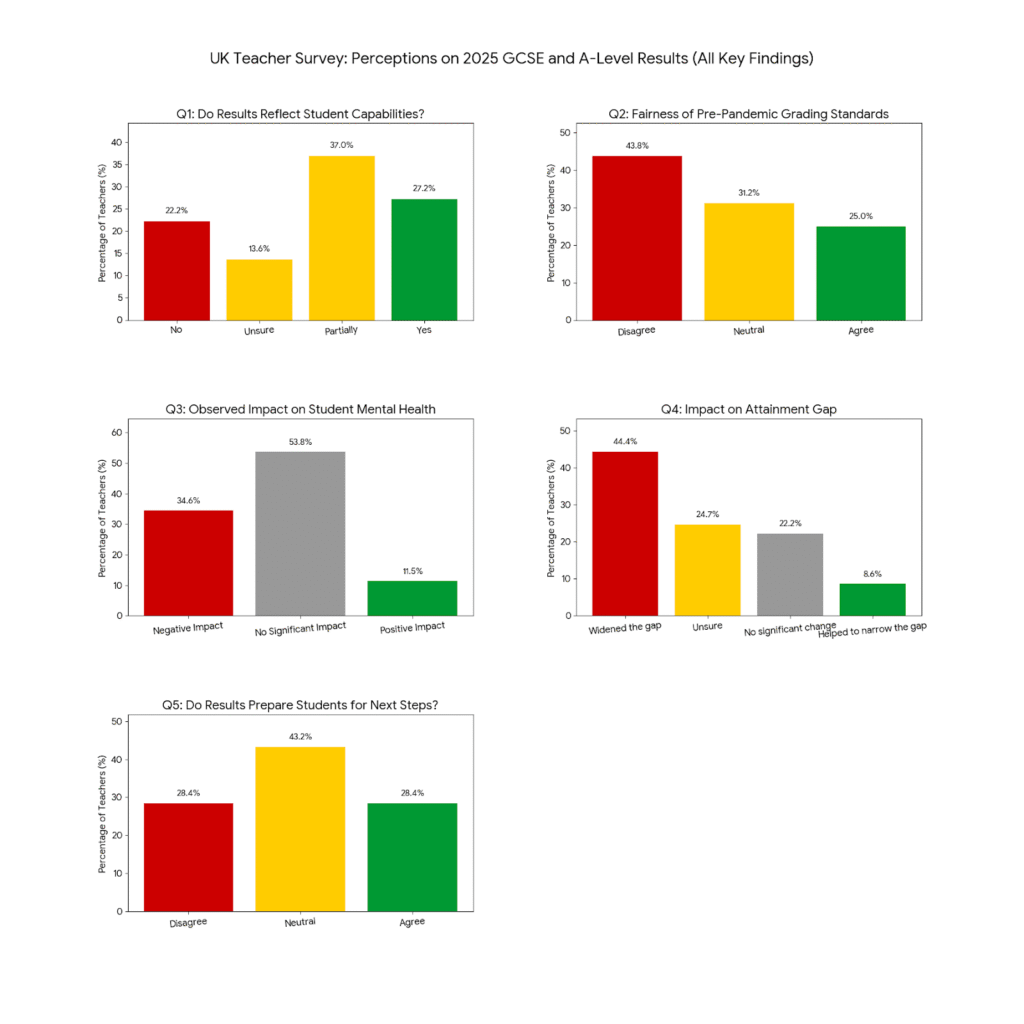
The return to pre-pandemic grading standards for the 2025 GCSE and A-Level results was heralded by policymakers as a necessary step to restore the rigour and value of UK qualifications. Yet, behind the official pronouncements, a clear chasm exists between political narrative and professional reality. An exclusive survey conducted by Only for Teachers reveals that a substantial majority of teachers hold deep reservations about the impact of the 2025 exams, particularly regarding fairness. The most significant finding paints a stark picture: 72% of teachers believe the 2025 results have actively widened the attainment gap between disadvantaged students and their peers.
The fairness of pre-pandemic grading standards
While the Department for Education (DfE) has focused on returning the system to a sense of ‘normalcy’ by aligning grade distributions with 2019 levels, our data suggests this transition has been anything but smooth for students still grappling with the lingering effects of disrupted learning.
When asked whether the move back to pre-pandemic grading fairness created a fair assessment environment for all students, a concerningly small minority were fully convinced. Only 18% of teachers fully agreed that the environment was fair. The majority, 55%, stated it was only Partially fair or expressed Neutral views, highlighting a critical lack of confidence in the equity of the final outcomes.
The impact of this policy shift is most acutely felt by the most vulnerable learners, as confirmed by the overwhelming consensus on the attainment gap widening.
For the vast majority of our professional community, this outcome is not a side effect, but a predictable consequence of removing grading flexibility before dealing with the underlying issues of disadvantage—such as chronic school underfunding and teacher shortages—have been fully resolved.
The data serves as a compelling counterpoint to the government’s recently announced commitment to the Workload Reduction Taskforce and the pledge to improve teacher retention. How can teachers be expected to close the attainment gap—the most complex and crucial task in UK education policy—when they perceive the very accountability metrics used by the system to be exacerbating the problem? The focus on a ‘return to rigour’ must be scrutinised when three-quarters of the profession believe this ‘rigour’ disproportionately penalises disadvantaged children.
Teacher views on external tutoring and inequality
Adding further complexity to the challenge of attainment gap widening is the rising prevalence of external tutoring. In a system under immense pressure, private support is actively creating a clear two-tier system, placing pupils whose families can afford supplemental tuition at a significant advantage.
Our survey asked teachers how they view students with external tutors, and the response was one of deep professional concern. 81% of comments expressed reservations, citing issues that undermine school-based teaching, such as students over-relying on the tutor, lack of communication between the private tutor and the classroom, and, most frequently, the fact that tutoring inherently contributes to educational inequality.
One teacher commented: “Tutoring does create another level of disadvantage because not all families can afford to pay privately.” Another highlighted the tension: “Sometimes the tutors tell the pupils the wrong thing!! Which is annoying as for some reason the pupils seem to trust what their tutors say more!”
This issue is interwoven with the current teacher retention crisis. As high-quality teachers leave the state sector—with recent OECD data confirming England has one of the worst attrition rates among developed nations—some are being absorbed into the private tuition market. This drain of expertise from state schools directly fuels the very inequality that the 2025 exam results have highlighted. The cycle of high workload, poor retention, and reliance on private income for experienced staff only serves to deepen the resource deficit for the most vulnerable students.
Conclusion and professional takeaway
The findings of this exclusive survey confirm that the professional teaching community views the 2025 exam results through a lens of equity, and what they see is deeply troubling. The clear majority consensus that the attainment gap widening is an acute problem cannot be ignored by policymakers. The data is an unmistakable mandate for systemic reform.
The primary takeaway for the sector must be directed at the highest levels of governance: policy cannot effectively achieve a return to pre-pandemic standards of rigour while actively undermining equity. The findings place pressure on the DfE and Ofqual to review the structural factors—including chronic underfunding and the teacher retention crisis—that have made this rapid return to 2019 grading unfair for disadvantaged pupils. The national debate must shift from simply discussing ‘rigour’ to fundamentally addressing the widening disparity this grading cycle has highlighted.
We urge all teachers to participate in next week’s survey, ensuring the professional voice remains the authoritative source in the national education debate.
Our Methodology
About this survey
All insights published on Only for Teachers come directly from teachers across the UK. Each week, we run original surveys on topics that matter most to educators — from classroom practice and workload to wellbeing and policy changes.
Who takes part
Participants are active UK teachers who have registered with Only for Teachers. Every response remains fully anonymous.
How we collect data
Our surveys are designed and distributed weekly through the Only for Teachers platform. Questions are short, relevant, and built to capture honest opinions efficiently. Each survey typically runs for one week, and responses are gathered using secure, GDPR-compliant forms.
Data integrity
We ensure one response per teacher, prevent duplicate entries, and apply basic data cleaning before publishing results. No weighting or external adjustments are made — what you see reflects the real voices of UK teachers.
How we analyse & publish
Responses are aggregated and summarised by the Only for Teachers research team. Results are published exclusively on our website and social channels and are original to this community. When relevant, we also feature selected teacher comments to add qualitative insights.
Use of insights
You’re welcome to reference or cite our findings in your articles, research, or policy papers — please credit: “Source: Only for Teachers – Original UK Teacher Survey Insights”